
The change in leadership at the railway ministry comes at a time when the national transporter is grappling with low passenger earnings even as it is trying to increase freight loading and open up its doors to private investment. Union Minister Ashwini Vaishnaw took charge from Piyush Goyal who got the railway portfolio in 2017 after Prime Minister Narendra Modii dropped Suresh Prabhu from the Union Cabinet. Completing freight corridors, negotiating land for the bullet train, and speeding up monetisation plans would be some of the major focus areas for Vaishnaw.
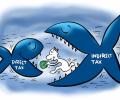
Before 2019, an estimated 22 million individual income-tax returns did not have to pay any taxes. But after the change in the exemption level, another 13 million individual tax returns did not require to pay taxes. Thus, of about 58 million returns, as much as 63 per cent or 35 million went out of the direct tax net, A K Bhattacharya points out.

It looks unlikely that a proper plan was in place or else the deaths could have been averted, reports Jyoti Mukul.

The notion that the BJP gained its increased tally by wiping out the Left parties and the Congress is completely misleading. Equally misleading is the belief that the TMC held its ground in all its existing seats. A little more than a fifth of the seats Mamata Banerjee's party had won in 2016 was lost to the BJP this time.

For deciding which vehicles are to be scrapped, the setting up of fitness centres and regulating them would be a humongous task.

The Tatas, L&T and Bharat Forge expressed interest in building pressure swing adsorption oxygen plants at hospital sites, while IOC and RIL are pitching in with both oxygen and cryogenic tankers needed for its transportation.
Any judgement on whether the March numbers reflect sustainable growth in GST collection should ideally await the numbers that will be out in May, points out A K Bhattacharya.
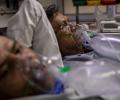
According to industry figures, the pre-Covid demand for liquid medical oxygen (LMO) before the pandemic was 700 tonnes per day across the country. Now, with the second wave, the demand has gone up more than seven times, reports Jyoti Mukul.
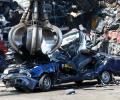
'Our automakers export 50 per cent of what they manufacture and once the policy comes into play, which is in the next 2-3 years, we would become a Rs 10 trillion industry.'

'We completed Rs 17 trillion worth of projects in the first term and currently Rs 9 trillion worth of contracts are under construction.'

When Nirmala Sitharaman announced her new privatisation policy, there were serious doubts if the move had the BJP's full political backing. All those doubts were dispelled when her initiatives were endorsed by Modi in Parliament, observes A K Bhattacharya.
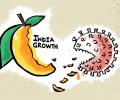
'The finance ministry's decision to accept the deficit target of 4.5 per cent in 2025-2026 appears to have emanated from its endorsement of the Finance Commission's view that the Indian economy will continue to remain impacted by the pandemic, adversely undermining its growth potential,' notes A K Bhattacharya.

But it is disappointing to note that Sitharaman's third Union Budget continues to promote a few problematic ideas, observes A K Bhattacharya.

Do the actual numbers bear out the claims made by the government or do they suggest something else? asks A K Bhattacharya.
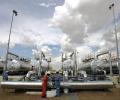
During a series of hectic talks between Cairn Energy and the Indian government over the $1.2-billion arbitration award in favour of the former last week, a slew of options was proposed by the two sides, including computation of capital gains and participation in the Vivad se Vishwas (VsV) dispute resolution scheme. The government is likely to go ahead and appeal against the arbitration award by a Permanent Court of Arbitration at The Hague before March 21, indicated finance ministry officials. Cairn Energy Plc on Sunday said it was hopeful that an acceptable solution to its tax dispute with the Indian government could be found to avoid prolonging and exacerbating the 'negative issue' for all parties.

A senior company executive said the company waited for seven years for the verdict and its shareholders needed to know when it would be concluded.

If eight states could join the VAT system much after the rollout date and after seeing how it works, why can't the same apply to states opposed to the farm laws, asks A K Bhattacharya.
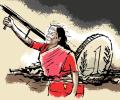
If Nirmala Sitharaman does indeed present a 'never-before' like Budget on February 1, going by her promise, she would create a new benchmark for post-contraction Budgets, observes A K Bhattacharya.
'But can it afford to present a scenario within the existing legal framework of fiscal consolidation?', asks A K Bhattacharya.

Can the finance minister manage our expectations, asks A K Bhattacharya.
 © 2026 Rediff.com - Advertise with us - Disclaimer - Privacy Policy - Sitemap - Feedback - About us - Terms of use - Grievances